
How Food & Beverage Innovation Consulting Teams Optimize Product Development From Concept to Commercialization
Summary and Key Takeaways
Food innovation consulting should guide the full journey, from early ambition through commercialization, not just isolated stages.
Strong innovation processes begin by aligning ambition, assets, and readiness, before ideation ever starts.
Concept development works best when feasibility, brand, and business realities are considered alongside creativity, not after.
Decision frameworks should determine which concepts move forward.
Commercialization success is designed upstream, when opportunity framing and concept choices account for real-world execution.
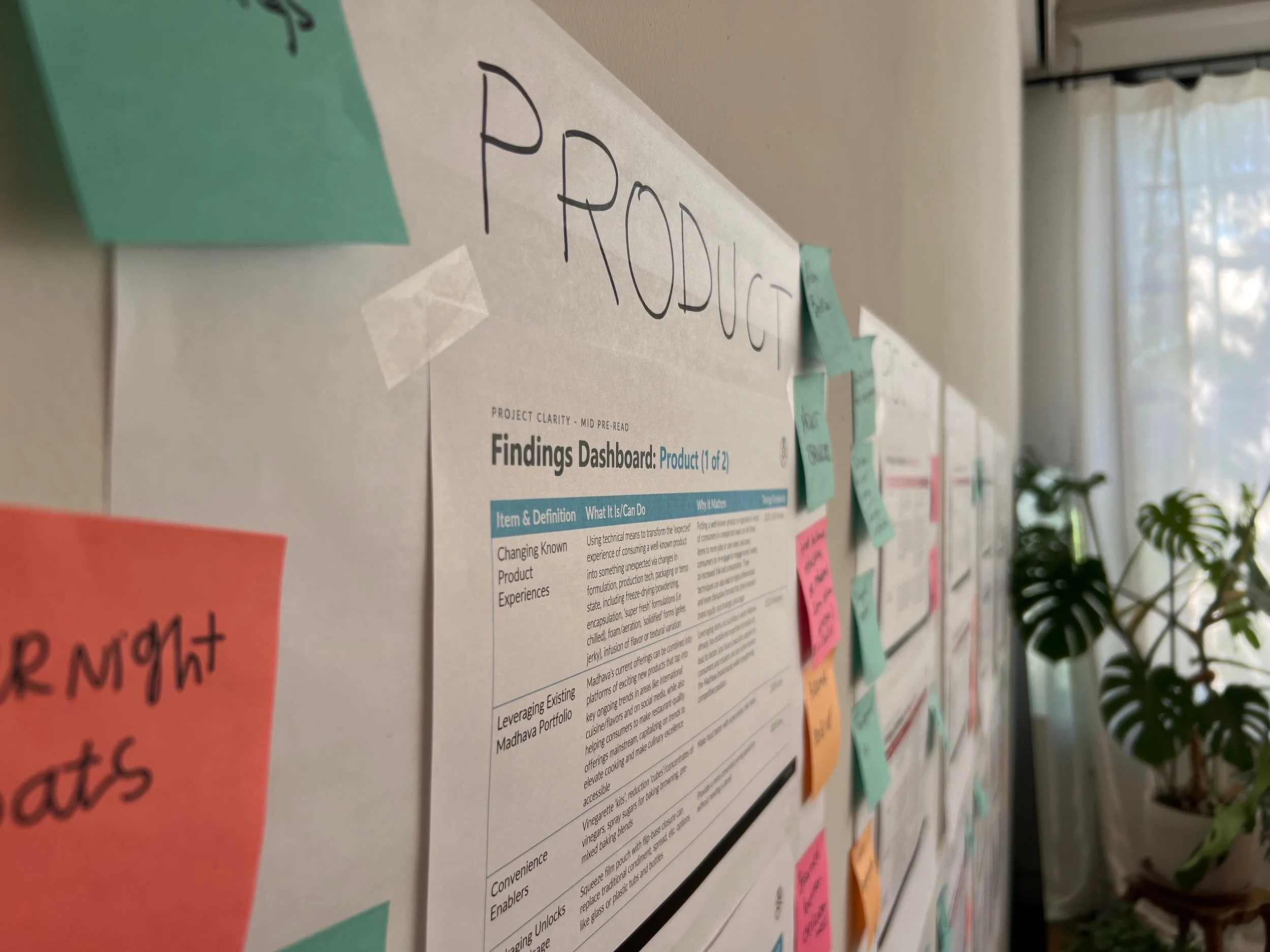
Strong innovation processes align ambition and market needs early in the process.
Food and beverage innovation is often described as a pipeline: insight becomes an idea, the idea takes shape as a product, then the product is launched into the market.
In practice, the work is far more interconnected. Decisions made early (often before a single concept is generated) shape what becomes feasible, scalable, and successful later. That’s why food innovation consulting is most effective when it treats concept and commercialization as part of the same system, rather than separate phases.
This article outlines how food & beverage innovation consulting should work from concept to commercialization, drawing on proven, cross-functional practices used by firms like Integral. The goal is not to sell a method, but to clarify what disciplined, modern innovation actually requires and why a complete approach produces better outcomes.
What Great Food Innovation Consulting Is Designed to Do
At its core, food innovation consulting exists to deliver creative ideas, strategic solutions, and deep execution expertise to guide food and beverage brands confidently from idea to success story.
That includes decisions about:
Where to focus innovation effort
What kinds of concepts to pursue
Which ideas deserve investment
How to move from idea to shelf without dilution
A great food innovation consultant helps teams:
Align on a shared definition of success
See across consumer, brand, operational, and commercial lenses
Create structure where ambiguity would otherwise stall progress
This work should span from concept through commercialization, not because every engagement runs end-to-end, but because each decision must account for what comes next.
Food innovation consulting helps ensure that concepts chosen earlier in the process are viable, scalable, and aligned with business realities, which reduces friction during development and launch.
Step 1: Establishing a Clear Innovation Ambition
Before ideation, before workshops, and before briefs, effective food innovation consulting begins by clarifying ambition.
This includes answering questions such as:
What growth opportunity are we solving?
What role should innovation play in the business?
How will success be measured, not just up through launch, but over time?
In practice, this work often takes the form of a short, focused alignment phase or readiness assessment. The goal is not exhaustive analysis, but shared clarity.
At Integral, this early phase aligns stakeholders on ambition, assets, guardrails, and readiness so teams can accelerate innovation without losing coherence.
When ambition is clearly defined:
Ideation becomes more focused and productive
Teams align faster
Concepts are pursued with greater conviction
Without agreement on what success looks like or why it’s even needed, teams generate ideas that are difficult to evaluate or prioritize later.
Step 2: Framing the Opportunity Before Generating Concepts
Once ambition is clear, the next responsibility of food innovation consulting is opportunity framing.
This step translates ambition into:
Clear opportunity spaces
Defined consumer jobs to be addressed
Brand guardrails and stretch boundaries
Early signals of feasibility and scale
Criteria for selection
Rather than asking “What ideas do we have?”, effective product innovation consultants help teams ask, “What needs to be true for innovation to succeed here?”
Integral’s approach emphasizes framing the opportunity in a way that teams can rally around by connecting vision, business context, and execution implications from the very beginning.
This framing works to shape everything that follows, including:
The type of concepts generated
The criteria used to evaluate them
The likelihood those concepts can survive commercialization
FAQ: Why does making the effort to frame (or reframing) the opportunity directly affect product innovation success?
Well-framed opportunities lead to concepts that are more likely to resonate with consumers white also being easier to develop, align, and scale because key conditions and goals are clear upfront.
Step 3: Concept Development with Business Reality in View
As any F&B leader will tell you, concept identification and development is where creativity peaks. It’s also where disconnects begin.
In effective food innovation consulting, concept identification and development is designed to balance:
Creative exploration
Consumer desirability
Brand fit
Operational and commercial plausibility
This does not mean narrowing ideas prematurely. It means expanding creativity within relevant guidelines.
Integral’s broader methodology, embodied in our Catalyst framework, explicitly integrates consumer, brand, financial, operational, organizational, and go-to-market considerations throughout ideation and refinement, rather than treating them as downstream checks.
The result is concepts that are:
More differentiated
Sufficiently articulated
Compared using the same criteria
Easier to evaluate
More resilient during development
It’s critical to understand that considering feasibility, and not just differentiation, early on increases the likelihood that innovative ideas can actually reach the market and perform.

Ensuring feasibility is foundational in food and beverage innovation consulting.
Step 4: Structured Evaluation and Decision-Making
One of the most important contributions of food innovation consulting is decision structure.
After ideation, teams can face:
Too many options
Conflicting functional opinions
Pressure to move quickly
Without clear criteria, decisions default to hierarchy or instinct.
Effective food innovation consulting introduces:
Transparent, relevant evaluation criteria
Cross-functional lenses applied consistently
Facilitated decision-making moments
Integral’s work emphasizes building decision frameworks that allow teams to compare concepts objectively, so decisions are informed, defensible, and aligned.
This clarity is essential before moving into development and commercialization, where costs and commitments increase significantly.
Step 5: Designing for Commercialization Early
Commercialization is not a final step; it should be considered early in the innovation journey as a design input.
Strong food innovation consulting integrates commercialization thinking while concepts are still being shaped, including:
Manufacturing pathways
Supply chain implications
Cost and margin expectations
Channel and customer fit
Integral’s approach explicitly connects innovation ideation and decisions to how products will be built, distributed, and activated in the market, creating a clear line of sight from concept to shelf.
When commercialization is considered early:
The original idea is better preserved
Fewer late-stage surprises emerge
Development timelines compress
Launch plans feel realistic rather than aspirational
Commercialization consideration should begin during concept identification and refinement, not after a concept is “locked in.”
Step 6: Supporting the Transition from Innovation to Build
As innovation moves into development and launch, food innovation consulting can often shift from leading to supporting; however, the work is not done.
At this stage, effective consultants help teams:
Translate strategy into actionable plans
Maintain alignment as execution details emerge
Adjust and refine without losing strategic intent
Integral’s model reflects this by supporting brands across strategy, innovation, and build efforts, ensuring continuity rather than handoff-driven loss of clarity.
This continuity is one reason holistic approaches outperform fragmented ones.
A More Connected, Cohesive Way to Innovate
From concept to commercialization, food and beverage innovation succeeds when decisions are made with clarity, context, and continuity.
Food innovation consulting, when practiced holistically, provides that connective tissue, helping teams move forward with confidence, not just momentum.
If your team is navigating how to move from ambition to shelf with clarity, a grounded conversation about process and decision-making can often be the most valuable place to start. Contact us - we’d love to hear from you.
People Also Ask: Food Innovation Consulting
What is food innovation consulting?
Food innovation consulting helps brands develop and commercialize new products by guiding opportunity framing, concept development, decision-making, and execution readiness.
What does a food innovation consultant do differently than a product developer?
A food innovation consultant focuses on strategic clarity, decision frameworks, and cross-functional alignment, while product developers focus on technical formulation and scale-up.
How does food innovation consulting support commercialization?
By ensuring concepts are chosen and refined with manufacturing, cost, and go-to-market realities in mind.
Is food innovation consulting only for large brands?
No. Founder-led and mid-size brands often benefit significantly, as early decisions carry higher relative risk.
What makes a holistic food innovation approach more effective?
It treats innovation as a connected system—linking ambition, ideation, feasibility, and commercialization from the start.
