
These Are the Signs That Your Brand Needs a CPG Innovation Consultant
Summary: These Signals Mean It’s Time to Bring in a CPG Innovation Consultant
If your team is generating ideas but struggling to choose, your innovation system lacks objective criteria. A CPG innovation consultant can provide you with structured evaluation so decisions are aligned and defensible.
If briefs feel reactive, you may be solving the wrong problem; the right CPG innovation consultant helps you better iterate the opportunity before resources are committed.
If feasibility surprises emerge late, execution wasn’t designed upstream; a holistic innovation partner integrates technical and operational realities early, alongside consumer, brand, and category.
If cross-functional swirl is slowing momentum, strong innovation facilitation from a CPG innovation expert creates clarity, confidence, and forward motion.
If innovation energy is high but outcomes are inconsistent, your process needs a decision engine, not more brainstorming.

A CPG innovation consultant can provide you with structured evaluation so decisions are aligned and defensible.
Innovation challenges in CPG often don’t appear because brand teams lack creativity. Typically, challenges result when clarity, structure, and alignment break down at critical moments during the innovation process.
Across food and beverage organizations, from founder-led brands to global portfolios, we see similar patterns emerge. The energy is there. The ambition is there. The pressure is real. Yet, something isn’t clicking.
If you’re wondering whether it’s time to bring in a CPG innovation consultant, this article is meant to help you recognize the signs. Because high-performing teams don’t wait until something collapses. They bring in support because they know that investing in an innovation expert increases the likelihood that they will end up with a product that performs.
1. Your Team is Active, But They’re Not Anchored
One of the clearest signals that a brand needs a CPG innovation consultant is this:
The team is busy.
The calendar is full.
Solutions are moving.
But no one can clearly articulate what problem you’re solving and why it matters now.
Research across innovation management consistently shows that how well the market opportunity is framed strongly influences downstream performance. Harvard Business Review has repeatedly highlighted how teams often jump to solutions before defining the core question, leading to rework and misalignment later.
In CPG specifically, poorly framed briefs often look like:
“We need a protein SKU.”
“Retail is asking for something new.”
“We should play in functional.”
“We need to respond to competitor X.”
Those are starting points. They are not opportunity definitions.
A strong CPG consultant doesn’t start by ideating. They start by asking sharper questions:
Why this?
Why now?
For whom?
What must be true for this to win?
How will we choose?
At Integral, we call this defining the right opportunity, not simply responding to a brief .
FAQ: How do I know if our opportunity framing isn’t working?
If different stakeholders describe the initiative differently, or if success criteria shift midstream, the opportunity likely isn’t clearly defined.
2. You Have Lots of Ideas, But No Clear Criteria to Select the Right one
This is one of the most common inflection points for a CPG innovation consultant.
The workshop happened.
The whiteboards are full.
Ideas exist.
And now the team is stuck.
McKinsey’s research on decision-making highlights that unclear decision rights and lack of structured criteria slow organizations dramatically. In innovation, that often shows up as:
Decisions defaulting to the loudest voice
Concepts advancing due to momentum, not merit
Endless “one more round” refinement
Defaulting to research to make the decision
The opportunity here is not to create more ideas. It is to build a decision engine.
Strong innovation systems deconstruct what makes a concept successful:
Consumer fit
Brand fit
Differentiation
Feasibility
Scalability
Economics
Business impact
Then they normalize ideas to a common standard and evaluate transparently.
This is one of our key differentiators here at Integral; many partners stop at ideas, but we build the choice architecture because we know that innovation is a system, not a series of disjointed decisions.
FAQ: What’s the difference between good ideation and a strong innovation system?
Ideation creates options. A strong system creates comparable options and a transparent path to one aligned decision.

Incorporating feasibility planning into the ideation stage of CPG innovation is critical.
3. Feasibility Surprises Are Derailing Momentum
If you’ve heard any of the following in the last six months, it may be time for a CPG consultant:
“We didn’t realize it would cost that much.”
“The co-man can’t support this format.”
“The line trial didn’t behave as expected.”
Industry reporting from Food Dive consistently shows how execution complexity and cost pressure are intensifying across food and beverage. The environment is less forgiving than it was a decade ago.
Late-stage feasibility friction is rarely random. It’s often a signal that execution realities weren’t integrated early enough. This is one of the predictable breakdown points in innovation: execution realities aren’t considered early enough .
A strong CPG innovation consultant:
Brings feasibility thinking into ideation
Integrates supply chain and commercialization early
Designs ambition that survives contact with reality
This doesn’t stifle creativity. It protects it.
FAQ: Should feasibility limit creativity?
No. It should inform it. The goal is not to shrink ideas, it’s to shape ideas that can scale. Shift the conversation to “what would it take” or “what would need to be true.”
4. Cross-Functional Swirl Is Slowing Decisions
Innovation leaders often describe this moment the same way:
“There are too many opinions.”
Marketing sees the consumer upside. R&D sees technical constraints. Sales sees retailer asks. Finance sees margin pressure.
All perspectives are valid. None are aligned.
Harvard Business Review research on collaboration overload shows how organizations can become gridlocked when too many stakeholders engage without clear structure.
This is where the right CPG innovation consultant acts as a neutral Navigator.
Bringing clarity to uncertain journeys
Knowing both the map and the terrain
Challenging and guiding in equal measure
We don’t drop a deck and disappear. We travel alongside the team to define and navigate the choice.
If your initiative feels emotionally charged, politically delicate, or stalled in debate, that’s not dysfunction; it’s a sign the stakes are high.
And high-stakes moments deserve structured facilitation.
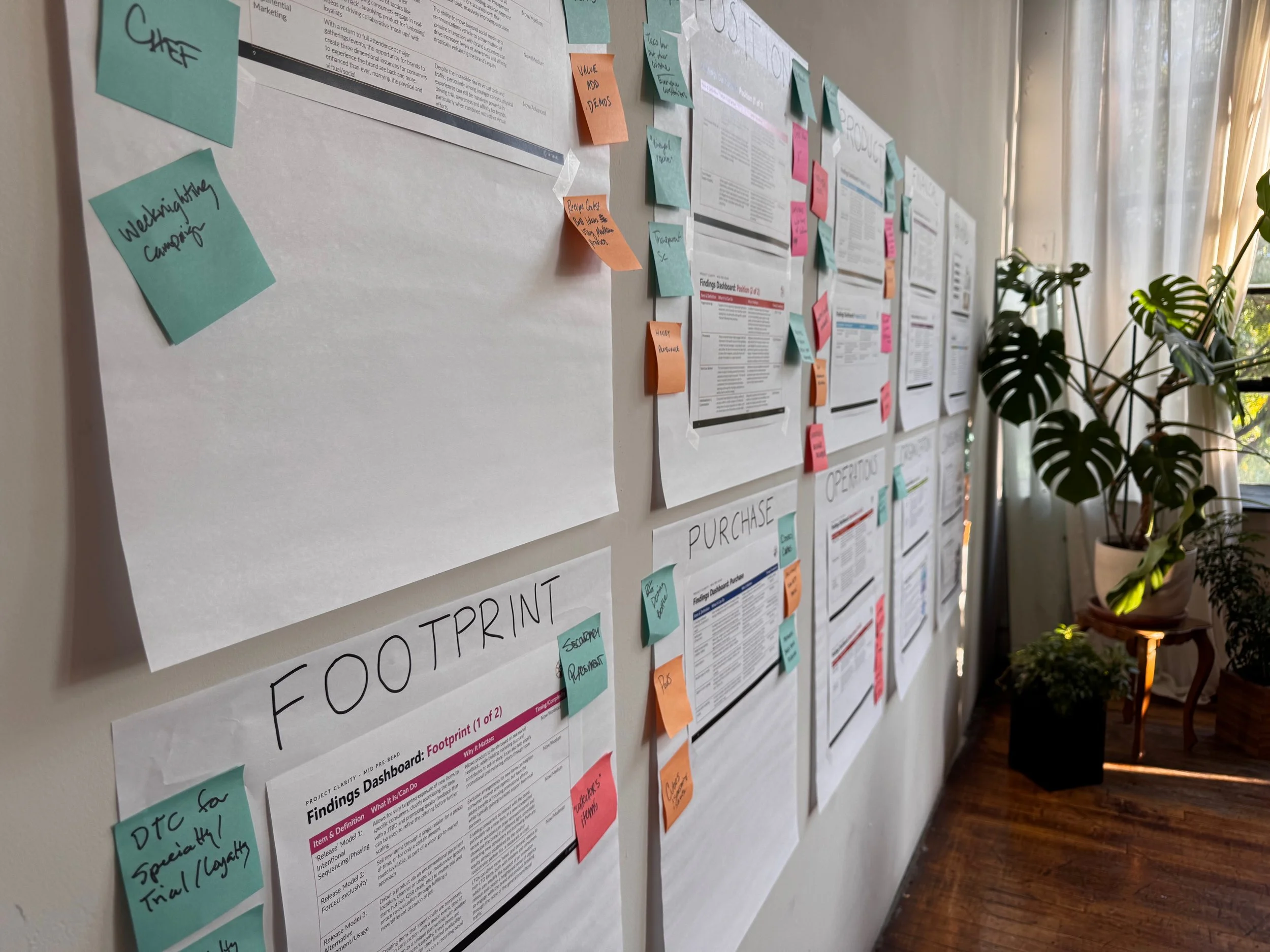
More ideas in CPG innovation does not always mean more impact.
5. Innovation Energy Is High, But Outcomes Are Inconsistent
Some brands don’t feel stuck. Instead, they feel busy.
They are launching frequently.
They are testing constantly.
They are experimenting widely.
But when you step back, the portfolio lacks coherence.
Mintel has reported that genuinely new food and beverage innovation has declined over the past decade, even as launch activity remains high. That suggests more activity does not always equal more impact.
This is a key sign that your team may benefit from a CPG innovation consultant:
Are launches laddering to a clear growth thesis?
Do new products expand revenue streams or cannibalize them?
Is innovation strengthening brand meaning or fragmenting it?
A structured innovation partner helps teams step back and assess:
The shape of the portfolio
The role of each innovation
The long-term business model implications
At Integral, we refer to this as an end-game mindset: seeing the full ecosystem, not just the product in front of you.
FAQ: How do we know if our innovation portfolio lacks coherence?
If you struggle to explain how your last three launches collectively support your five-year growth ambition, your system likely needs alignment.
6. You’re at a Critical Moment of Choice
Sometimes the sign is less structural and more visceral.
You are about to:
Present to the board
Enter a new category
Commit significant capital
Align a global team
Make a high-visibility decision
And you feel the weight of it.
This is often when brands call a CPG innovation consultant, not because something failed, but because the cost of choosing wrong is too high.
What a Strong CPG Innovation Consultant Actually Does
It’s important to clarify what this role is, and what it is not.
A strong CPG consultant:
Does not replace your team
Does not impose an agenda
Does not deliver theoretical frameworks disconnected from reality
Instead, they:
Clarify the problem before solving it
Design intentional ideation
Build structured evaluation criteria
Facilitate aligned decisions
Integrate execution realities early
Stay connected as work moves toward shelf
In the simplest terms, as our messaging outlines:
Create better options
Drive informed, intentional decisions
Create the best outcome
In Summary
Needing a CPG innovation consultant is not a sign that your team lacks talent. It is a sign that:
The stakes are meaningful.
The decision matters.
The opportunity is worth protecting.
If you recognize yourself in these signals and want a partner to help define the right opportunity, compare your options objectively, and guide your team to one aligned direction, reach out to us for a discovery call. We will bring clarity, intention, and confidence to whatever stage of innovation you’re in.
People Also Ask
What does a CPG innovation consultant do?
A CPG innovation consultant helps brands define the right opportunity, generate viable product options, build objective evaluation frameworks, and guide aligned decisions from idea through commercialization.
When should a brand hire a CPG consultant?
When innovation initiatives stall due to unclear framing, misalignment, lack of objective criteria, or execution surprises — especially when the cost of choosing wrong is high.
How is a CPG innovation consultant different from an R&D firm?
R&D firms focus primarily on formulation and technical execution. A CPG innovation consultant bridges consumer insight, brand strategy, feasibility, and commercialization to guide the decision architecture upstream.
Do large CPG companies need innovation consultants?
Yes — often to unlock stalled cross-functional initiatives, provide neutral facilitation, and accelerate alignment in complex organizations.
Is hiring a consultant a sign of internal weakness?
No. It is often a signal that leadership takes innovation seriously enough to invest in decision quality.
